> ## Documentation Index
> Fetch the complete documentation index at: https://docs.macropay.ai/llms.txt
> Use this file to discover all available pages before exploring further.
# Handle & monitor webhook deliveries
> Receive, verify and react to Macropay webhooks — with delivery monitoring, retries and troubleshooting built in
 Webhooks are how your app learns what happened. As your Merchant of Record,
Macropay settles the payment, remits the sales tax or VAT, and absorbs the PCI
and dispute handling — then fires an event so your code can do its part: grant a
license, unlock a download, provision a seat, or top up prepaid credits. The
same applies to usage- and agent-driven billing: when an order or subscription
moves, a webhook is your signal to react.
This page covers the full lifecycle: building a receiver that verifies and
parses events, the network and reliability guarantees you can rely on, and how
to monitor and debug deliveries from the dashboard.
## Monitor deliveries in the dashboard
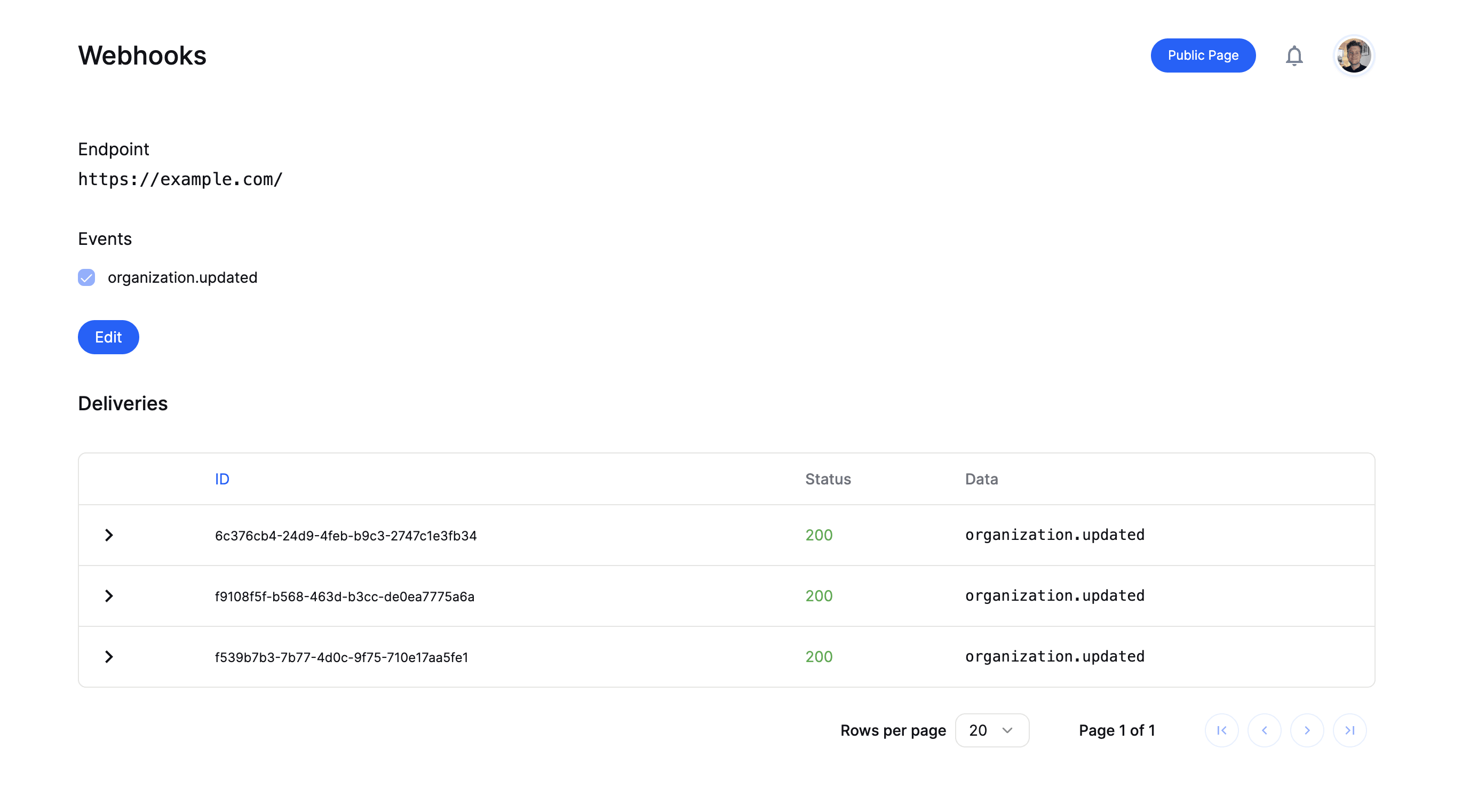
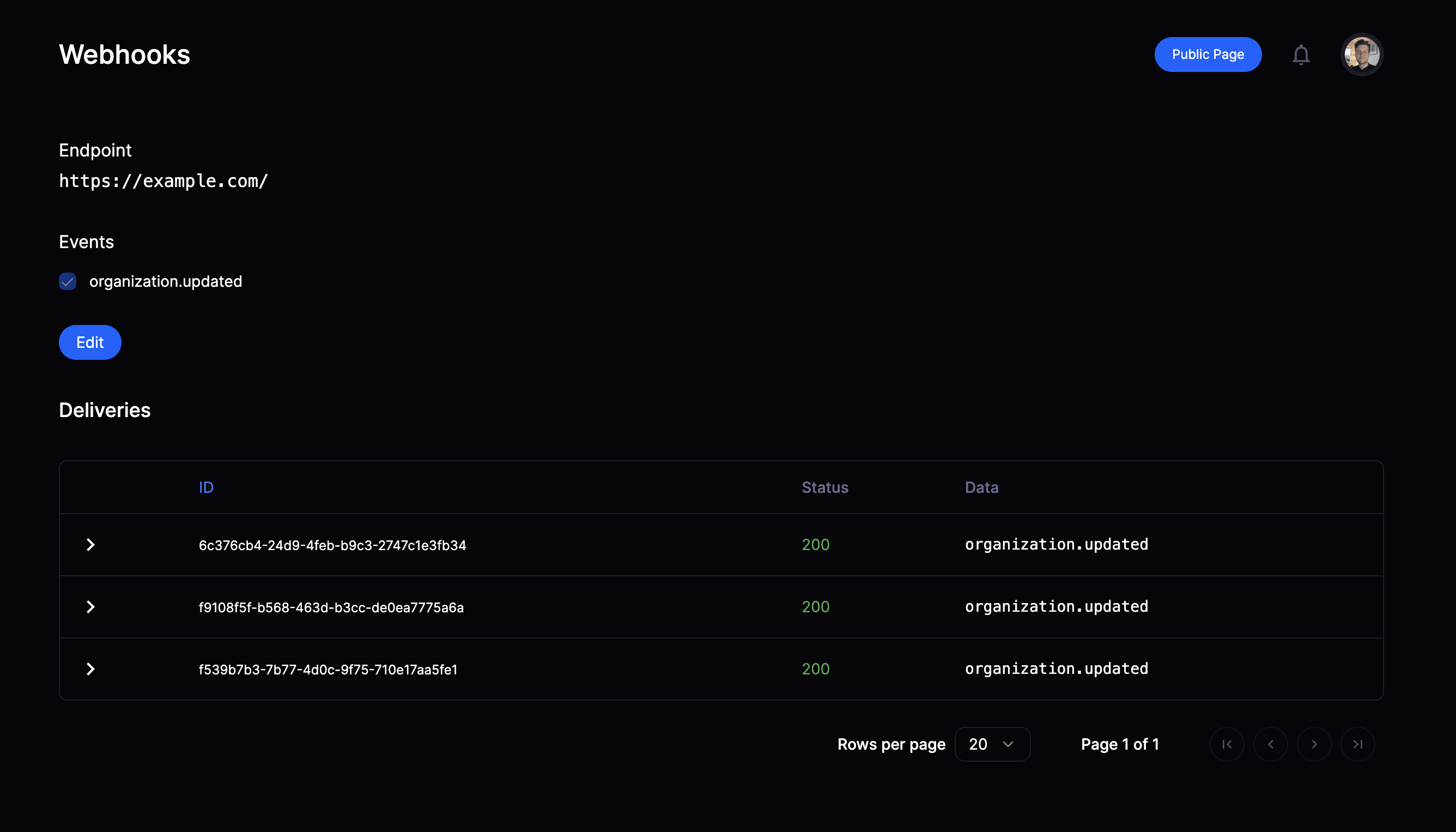
Every registered endpoint gets a delivery overview. From there you can:
* Browse the full history of delivery attempts
* Inspect the exact payload that was sent
* Replay any delivery — useful after you ship a fix for a failing handler
Keep this open while you wire up your route below; it's the fastest way to
confirm events are leaving Macropay and to see the status code your endpoint
returned.
## Build your receiver
Register a route at the URL you configured on Macropay, then verify the
signature, parse the payload, and branch on the event type before doing any
work.
### With the SDKs
The TypeScript and Python SDKs ship a single helper that verifies the signature
and returns a typed event in one step.
```typescript icon="square-js" JS (Express) theme={null}
import express, { Request, Response } from 'express'
import { validateEvent, WebhookVerificationError } from '@macropayments/sdk/webhooks'
const app = express()
app.post(
'/webhook',
express.raw({ type: 'application/json' }),
(req: Request, res: Response) => {
try {
const event = validateEvent(
req.body,
req.headers,
process.env['MACROPAY_WEBHOOK_SECRET'] ?? '',
)
// Branch on the event and hand off to a background worker
switch (event.type) {
case 'order.paid':
// e.g. queue entitlement grant for event.data.customer_id
break
case 'subscription.canceled':
// e.g. queue access revocation
break
}
// Acknowledge fast — return 2xx before doing heavy work
res.status(202).send('')
} catch (error) {
if (error instanceof WebhookVerificationError) {
res.status(403).send('')
}
throw error
}
},
)
```
```python Python (Flask) theme={null}
import os
from flask import Flask, request
from macropay_sdk.webhooks import validate_event, WebhookVerificationError
app = Flask(__name__)
@app.route('/webhook', methods=['POST'])
def webhook():
try:
event = validate_event(
body=request.data,
headers=request.headers,
secret=os.getenv('MACROPAY_WEBHOOK_SECRET', ''),
)
# Branch on the event and hand off to a background worker
if event.type == 'order.paid':
... # e.g. enqueue entitlement grant for event.data.customer_id
elif event.type == 'subscription.canceled':
... # e.g. enqueue access revocation
# Acknowledge fast — return 2xx before doing heavy work
return "", 202
except WebhookVerificationError:
return "", 403
```
Both samples read the signing secret from an environment variable named
`MACROPAY_WEBHOOK_SECRET`. Set it to the secret shown when you created the
endpoint.
### Rolling your own verification
Macropay signs every event using the
[Standard Webhooks](https://www.standardwebhooks.com/) specification, so you can
drop in any of the
[community libraries](https://github.com/standard-webhooks/standard-webhooks/tree/main/libraries)
across languages — or follow the
[spec](https://github.com/standard-webhooks/standard-webhooks/blob/main/spec/standard-webhooks.md)
directly if you'd rather implement it yourself.
**The secret must be base64-encoded**
The most common mistake when verifying by hand is forgetting that the signing
secret is base64-encoded before the signature is computed. The SDK handles this
for you; if you roll your own, decode the secret first.
## Network allowlist
If a firewall or reverse proxy sits in front of your endpoint, allow the
following ranges so deliveries can reach you.
**New IP ranges**
Starting **October 27th, 2025**, these ranges are added to the list:
```
74.220.50.0/24
74.220.58.0/24
```
```txt Production theme={null}
3.134.238.10
3.129.111.220
52.15.118.168
74.220.50.0/24
74.220.58.0/24
```
```txt Sandbox theme={null}
3.134.238.10
3.129.111.220
52.15.118.168
74.220.50.0/24
74.220.58.0/24
```
## Reliability guarantees
Macropay does the heavy lifting to get each event delivered. Here's what to
expect, and what's expected of your handler.
| Behavior | Detail |
| ----------------------------- | --------------------------------------------------------------------------------------- |
| **Retries** | Up to **10 attempts** with exponential backoff on any non-2xx response or network error |
| **Timeout** | Requests are cut off after **10 seconds**, which triggers a retry |
| **Recommended response time** | Acknowledge within **2 seconds** |
| **Auto-disable** | An endpoint is disabled after **10 consecutive failed deliveries** |
**Respond fast, work later**
The timeout may tighten over time. Treat the webhook handler as a fast
acknowledgement layer: verify, enqueue a background task, and return a 2xx
immediately. Doing real work inline risks timeouts and unnecessary retries.
### When an endpoint is disabled
After 10 consecutive non-2xx responses, the endpoint stops receiving new events
and your organization's admins get an email notification. To recover:
1. Confirm the endpoint is reachable and returning 2xx (use redelivery from the
dashboard to test).
2. Re-enable it under your organization's webhook settings.
Re-enabling before the underlying issue is fixed will simply trip the
auto-disable again.
## Troubleshooting
Seeing deliveries leave Macropay but nothing arriving on your end? Start with
the basics, then match the reported status code below.
**First checks**
* **Tunnel still live?** When testing locally, confirm your tunnel (ngrok,
Cloudflare Tunnel, etc.) is up and its public URL still matches the endpoint
configured on Macropay.
* **Log generously.** Emit markers like `webhook.handler_called`,
`webhook.signature_validated`, and `webhook.handled` so you can see whether
the handler ran and how far it got.
**By status code**
| Status | Likely cause & fix |
| ------ | ---------------------------------------------------------------------------------------------------------------------------------------------------------------------------------------------------------------------------------------------- |
| `404` | Route not found. Run `curl -vvv -X POST ` to confirm it exists; many frameworks resolve `/foo` to `/foo/`, so try adding a trailing slash on Macropay. |
| `3xx` | Redirects (301, 302, 307…) count as failures — Macropay does not follow them. Point the webhook at the final URL. A frequent culprit is host-level `www` ↔ non-`www` redirects (e.g. on Vercel); match your configured URL to the real domain. |
| `403` | Auth middleware or a bot filter is blocking the request. See below. |
**Resolving `403`**
* If you protect routes with authorization middleware, exclude the webhook path
— it must be publicly reachable.
* On Cloudflare:
* Check the firewall logs to see whether requests are blocked, and add a WAF
rule to accept traffic from Macropay's IP ranges.
* **Bot Fight Mode** is a common cause: it blocks legitimate webhook traffic,
and neither IP allowlisting nor custom WAF rules override it. Disable it
under **Security → Bots**, then re-test.
### Invalid signature errors
Verifying signatures yourself? Base64-decode the secret you configured on
Macropay before computing the signature — a raw secret will never match.
Webhooks are how your app learns what happened. As your Merchant of Record,
Macropay settles the payment, remits the sales tax or VAT, and absorbs the PCI
and dispute handling — then fires an event so your code can do its part: grant a
license, unlock a download, provision a seat, or top up prepaid credits. The
same applies to usage- and agent-driven billing: when an order or subscription
moves, a webhook is your signal to react.
This page covers the full lifecycle: building a receiver that verifies and
parses events, the network and reliability guarantees you can rely on, and how
to monitor and debug deliveries from the dashboard.
## Monitor deliveries in the dashboard
Every registered endpoint gets a delivery overview. From there you can:
* Browse the full history of delivery attempts
* Inspect the exact payload that was sent
* Replay any delivery — useful after you ship a fix for a failing handler
Keep this open while you wire up your route below; it's the fastest way to
confirm events are leaving Macropay and to see the status code your endpoint
returned.
## Build your receiver
Register a route at the URL you configured on Macropay, then verify the
signature, parse the payload, and branch on the event type before doing any
work.
### With the SDKs
The TypeScript and Python SDKs ship a single helper that verifies the signature
and returns a typed event in one step.
```typescript icon="square-js" JS (Express) theme={null}
import express, { Request, Response } from 'express'
import { validateEvent, WebhookVerificationError } from '@macropayments/sdk/webhooks'
const app = express()
app.post(
'/webhook',
express.raw({ type: 'application/json' }),
(req: Request, res: Response) => {
try {
const event = validateEvent(
req.body,
req.headers,
process.env['MACROPAY_WEBHOOK_SECRET'] ?? '',
)
// Branch on the event and hand off to a background worker
switch (event.type) {
case 'order.paid':
// e.g. queue entitlement grant for event.data.customer_id
break
case 'subscription.canceled':
// e.g. queue access revocation
break
}
// Acknowledge fast — return 2xx before doing heavy work
res.status(202).send('')
} catch (error) {
if (error instanceof WebhookVerificationError) {
res.status(403).send('')
}
throw error
}
},
)
```
```python Python (Flask) theme={null}
import os
from flask import Flask, request
from macropay_sdk.webhooks import validate_event, WebhookVerificationError
app = Flask(__name__)
@app.route('/webhook', methods=['POST'])
def webhook():
try:
event = validate_event(
body=request.data,
headers=request.headers,
secret=os.getenv('MACROPAY_WEBHOOK_SECRET', ''),
)
# Branch on the event and hand off to a background worker
if event.type == 'order.paid':
... # e.g. enqueue entitlement grant for event.data.customer_id
elif event.type == 'subscription.canceled':
... # e.g. enqueue access revocation
# Acknowledge fast — return 2xx before doing heavy work
return "", 202
except WebhookVerificationError:
return "", 403
```
Both samples read the signing secret from an environment variable named
`MACROPAY_WEBHOOK_SECRET`. Set it to the secret shown when you created the
endpoint.
### Rolling your own verification
Macropay signs every event using the
[Standard Webhooks](https://www.standardwebhooks.com/) specification, so you can
drop in any of the
[community libraries](https://github.com/standard-webhooks/standard-webhooks/tree/main/libraries)
across languages — or follow the
[spec](https://github.com/standard-webhooks/standard-webhooks/blob/main/spec/standard-webhooks.md)
directly if you'd rather implement it yourself.
**The secret must be base64-encoded**
The most common mistake when verifying by hand is forgetting that the signing
secret is base64-encoded before the signature is computed. The SDK handles this
for you; if you roll your own, decode the secret first.
## Network allowlist
If a firewall or reverse proxy sits in front of your endpoint, allow the
following ranges so deliveries can reach you.
**New IP ranges**
Starting **October 27th, 2025**, these ranges are added to the list:
```
74.220.50.0/24
74.220.58.0/24
```
```txt Production theme={null}
3.134.238.10
3.129.111.220
52.15.118.168
74.220.50.0/24
74.220.58.0/24
```
```txt Sandbox theme={null}
3.134.238.10
3.129.111.220
52.15.118.168
74.220.50.0/24
74.220.58.0/24
```
## Reliability guarantees
Macropay does the heavy lifting to get each event delivered. Here's what to
expect, and what's expected of your handler.
| Behavior | Detail |
| ----------------------------- | --------------------------------------------------------------------------------------- |
| **Retries** | Up to **10 attempts** with exponential backoff on any non-2xx response or network error |
| **Timeout** | Requests are cut off after **10 seconds**, which triggers a retry |
| **Recommended response time** | Acknowledge within **2 seconds** |
| **Auto-disable** | An endpoint is disabled after **10 consecutive failed deliveries** |
**Respond fast, work later**
The timeout may tighten over time. Treat the webhook handler as a fast
acknowledgement layer: verify, enqueue a background task, and return a 2xx
immediately. Doing real work inline risks timeouts and unnecessary retries.
### When an endpoint is disabled
After 10 consecutive non-2xx responses, the endpoint stops receiving new events
and your organization's admins get an email notification. To recover:
1. Confirm the endpoint is reachable and returning 2xx (use redelivery from the
dashboard to test).
2. Re-enable it under your organization's webhook settings.
Re-enabling before the underlying issue is fixed will simply trip the
auto-disable again.
## Troubleshooting
Seeing deliveries leave Macropay but nothing arriving on your end? Start with
the basics, then match the reported status code below.
**First checks**
* **Tunnel still live?** When testing locally, confirm your tunnel (ngrok,
Cloudflare Tunnel, etc.) is up and its public URL still matches the endpoint
configured on Macropay.
* **Log generously.** Emit markers like `webhook.handler_called`,
`webhook.signature_validated`, and `webhook.handled` so you can see whether
the handler ran and how far it got.
**By status code**
| Status | Likely cause & fix |
| ------ | ---------------------------------------------------------------------------------------------------------------------------------------------------------------------------------------------------------------------------------------------- |
| `404` | Route not found. Run `curl -vvv -X POST ` to confirm it exists; many frameworks resolve `/foo` to `/foo/`, so try adding a trailing slash on Macropay. |
| `3xx` | Redirects (301, 302, 307…) count as failures — Macropay does not follow them. Point the webhook at the final URL. A frequent culprit is host-level `www` ↔ non-`www` redirects (e.g. on Vercel); match your configured URL to the real domain. |
| `403` | Auth middleware or a bot filter is blocking the request. See below. |
**Resolving `403`**
* If you protect routes with authorization middleware, exclude the webhook path
— it must be publicly reachable.
* On Cloudflare:
* Check the firewall logs to see whether requests are blocked, and add a WAF
rule to accept traffic from Macropay's IP ranges.
* **Bot Fight Mode** is a common cause: it blocks legitimate webhook traffic,
and neither IP allowlisting nor custom WAF rules override it. Disable it
under **Security → Bots**, then re-test.
### Invalid signature errors
Verifying signatures yourself? Base64-decode the secret you configured on
Macropay before computing the signature — a raw secret will never match.