> ## Documentation Index
> Fetch the complete documentation index at: https://docs.macropay.ai/llms.txt
> Use this file to discover all available pages before exploring further.
# Merchant of Record
> We become the seller of record so global sales tax, PCI, and disputes stop being your problem.
When you sell through Macropay, **we are the legal seller of record** — not just a
payment processor sitting between you and a card network. Your customer's bank
statement shows Macropay. The invoice is issued by Macropay. And the obligation to
calculate, collect, and remit sales tax / VAT / GST in every jurisdiction you reach
belongs to Macropay, not you.
That single shift removes the most painful part of monetizing software
internationally: you ship product, we own the tax, PCI, and dispute machinery
underneath it.
**Merchant of Record handles indirect taxes — never your income tax.** We collect
and remit US Sales Tax, EU VAT, UK VAT, Canadian GST and the like. You remain
responsible for income/revenue tax in your own country of residency.
## PSP or MoR?
The right answer depends on how much of the billing stack you want to own.
### Payment Service Providers
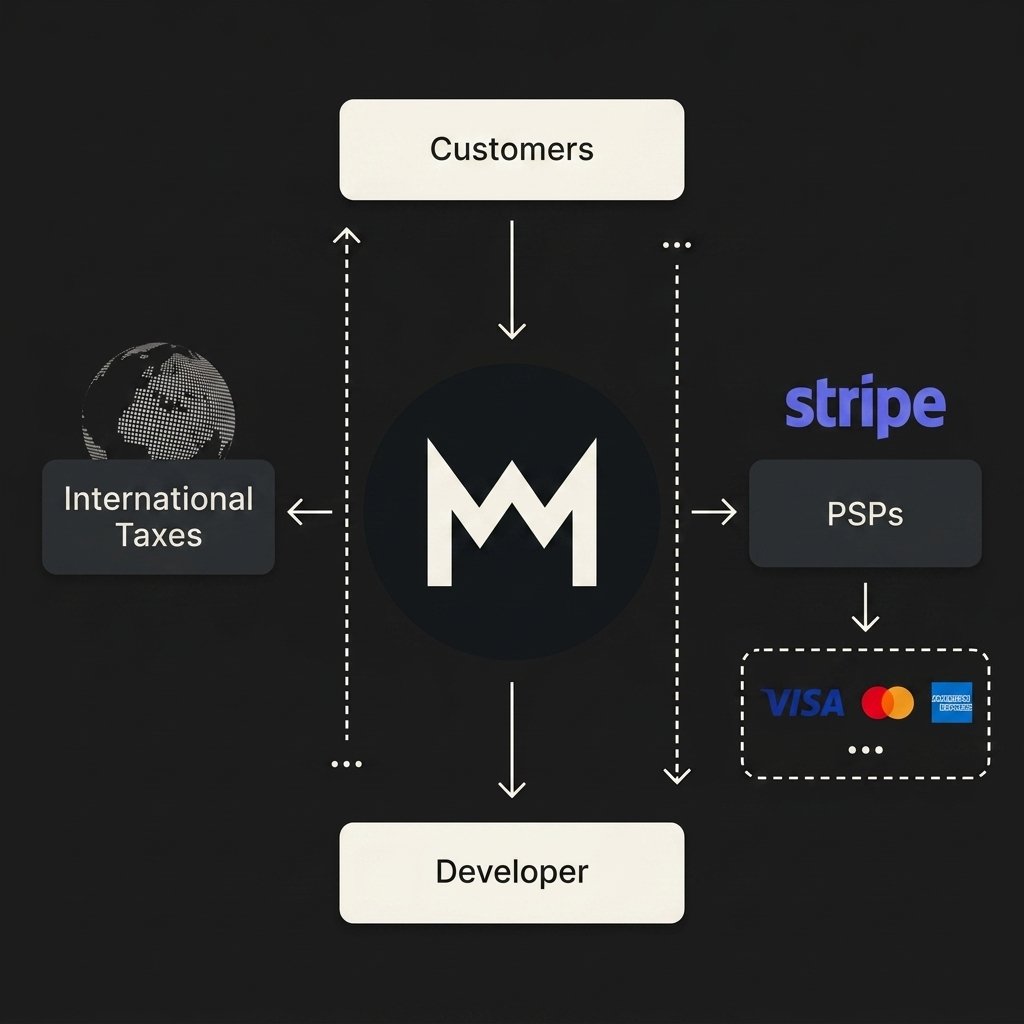
 A PSP — Stripe, Adyen, Checkout.com and peers — gives you a clean abstraction over
the card networks and acquiring banks so you can charge a card without operating
those relationships yourself. The tradeoff is that *everything around* the charge
stays with you.
| | PSP (direct) |
| ------------------ | ---------------------------------------------------------------------------- |
| **APIs** | Low-level, flexible primitives — power any model, but more to build |
| **Pricing models** | Anything you can engineer |
| **Tax** | **You** register, collect, file, and remit in every jurisdiction you trigger |
| **Disputes & PCI** | **Your** responsibility |
### Merchants of Record
A PSP — Stripe, Adyen, Checkout.com and peers — gives you a clean abstraction over
the card networks and acquiring banks so you can charge a card without operating
those relationships yourself. The tradeoff is that *everything around* the charge
stays with you.
| | PSP (direct) |
| ------------------ | ---------------------------------------------------------------------------- |
| **APIs** | Low-level, flexible primitives — power any model, but more to build |
| **Pricing models** | Anything you can engineer |
| **Tax** | **You** register, collect, file, and remit in every jurisdiction you trigger |
| **Disputes & PCI** | **Your** responsibility |
### Merchants of Record
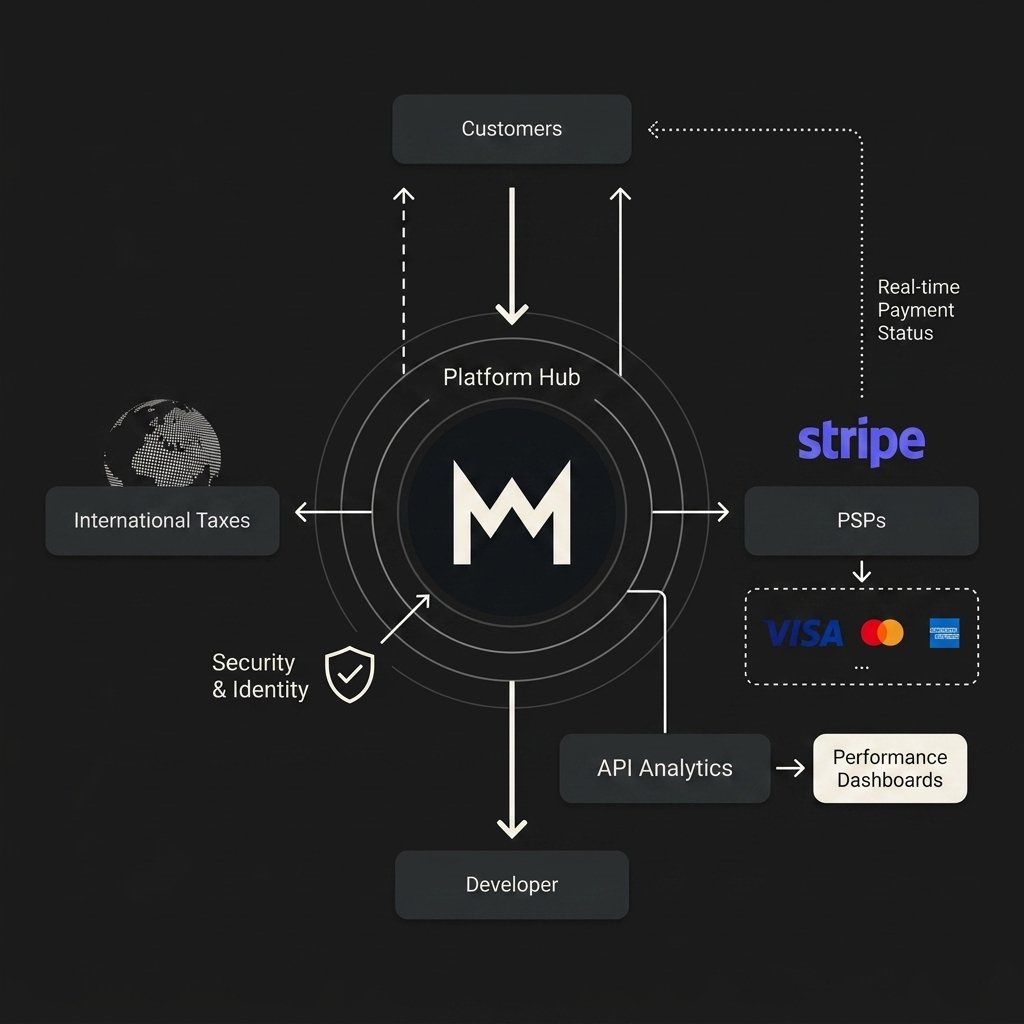
 An MoR sits *on top of* the PSP layer and fulfills the complete digital order, not
just the card capture. Macropay routes inbound payments across **multiple licensed
PSPs** and handles the rest in-house — invoicing, tax, refunds, chargebacks, and
payouts. Card data is **tokenized in our PCI DSS Level 1 compliant vault**, so PCI
scope never lands on your servers.
| | Macropay (MoR) |
| ------------------ | --------------------------------------------------------------------------------- |
| **APIs** | Higher-level dashboard, API & SDKs built for products, orders & subscriptions |
| **Tax** | **We** are the reseller of record — we collect and remit indirect taxes worldwide |
| **Disputes & PCI** | We manage chargebacks and absorb PCI scope |
| **Tradeoff** | Slightly higher per-transaction fee; less low-level control |
**Choosing in one line.** Take a raw PSP if you already shipped on one, want
absolute low-level control, or are optimizing purely for the lowest processing
fee — and you're fine owning tax, invoicing, and disputes. Choose Macropay if you
want product, customer, order, and subscription management out of the box,
built-in benefits like license keys, file downloads, Discord and private GitHub
invites, and someone else to own international tax.
## Built for usage and agent billing
Being the seller of record isn't only about classic checkout. Macropay computes the
correct tax at checkout **regardless of pricing model** — fixed, free,
pay-what-you-want, seat-based, or usage-based metered billing.
That matters most for the newest billing pattern: **AI agents that bill by usage,
activity, or outcome.** Whether an agent is metered on tokens through the
OpenAI-compatible AI proxy or charged on a certified outcome via the Signals API,
the resulting sale still needs tax handled correctly in the buyer's country — and as
MoR, we do that for you on every transaction your agents generate.
## How we actually handle the tax
Most MoRs simply tell you "we handle tax globally, don't worry about it." We do too —
but we'd rather show our work, so you can judge it (and decide whether to do it
yourself).
### What "handling tax" means
Nearly every country, state, and jurisdiction taxes digital goods and services
(VAT, GST, US Sales Tax), whether or not the seller is resident there. Compliance is
two obligations:
Charge the customer the correct tax-inclusive amount and ring-fence the tax
portion separately from your balance. Macropay computes the right rate at
checkout and holds captured tax apart from your funds.
File and pay that captured tax to each local authority on time. Macropay owns
registration, filing, and remittance in every jurisdiction where we're the MoR.
Rates, thresholds, and rules differ everywhere. A worked example — a **€20/month
plan sold into Germany (19% VAT)**:
* A **consumer** pays **€23.80/month**; €3.80 is ring-fenced for the German tax
authority.
* A **VAT-registered business** pays **€20.00/month** — the reverse-charge mechanism
shifts the VAT accounting to the buyer.
Some jurisdictions (UK, EU) require registration before your first sale; others
(e.g. Texas) don't until you cross a large threshold — Texas only after \$500,000 in
sales 🇺🇸🦅. It is genuinely hard: even large companies don't get it perfect, and
many delay compliance as a calculated risk, accepting back-taxes and penalties as a
cost of moving fast.
### The two paths, side by side
| | Direct PSP | Macropay (MoR) |
| ------------------------------------- | ----------------------------------------- | ---------------------------------------------- |
| Whose volume counts toward thresholds | Only yours — tax may not apply yet | Ours — so tax applies for more customers |
| Inbound VAT deductions | You can deduct against your own purchases | You can't claim them yourself |
| EU B2B VAT | You must register, capture & remit | Handled, including expected B2B reverse charge |
| Liability for register / file / remit | **You** | **Us** |
## Macropay's coverage
We support global payments and take on liability for international indirect taxes
everywhere we operate, then expand formal registrations as the data warrants.
**Current registrations**
1. **United States** — Macropay Software Inc. is a Delaware C Corp; registers for
state Sales Tax as thresholds are reached.
2. **EU VAT** — Irish One Stop Shop (OSS).
3. **UK VAT**.
No MoR registers everywhere up front — it's unnecessary under threshold rules and
prohibitively expensive with uncertain ROI. We work with global accounting firms who
specialize in registration, filing, and remittance, so we can scale coverage on
demand.
**The economics, transparently.** A new market costs us roughly **$500** to
register, **~$300** per (roughly quarterly) filing, plus consultations and our own
reporting effort — on the order of **$1,700 in year one and $1,200 per year after**.
In a market with 20% sales tax, standalone tax liability starts to outweigh those
costs around \*\*$6,000** in sales ($1,200 ÷ 20%). For Macropay, at a \~1.1% premium
over a raw PSP, we'd need about \*\*$109,090** in that market before our spread covers
the accounting cost ($1,200 ÷ 1.1%).
Most of our customers sell into the US, UK, and EU, so given US thresholds and our
existing registrations this is largely a non-issue. In markets where we aren't yet
registered, we still carry the liability while we assess long-term potential — and
we're comfortable betting on a market well before it's profitable for us. Where
neither holds in the near term, we reserve the right to temporarily block payments
from a country until the opportunity changes.
**Want to run tax yourself?** If you're selling enough that ongoing compliance
costs are worth it, reach out — we're happy to introduce you to the accounting
firms we work with. MoR is a core value-add, not the only reason Macropay exists;
our goal is to be the easiest way for developers to monetize, and we'll salute
anyone shipping software regardless of which billing platform they choose.
## Frequently Asked Questions
Macropay's VAT number is `EU372061545`. This is an EU One Stop Shop (OSS)
registration, which lets a non-EU business like Macropay (a Delaware C
Corporation) handle VAT for all EU countries through a single registration in
Ireland.
OSS VAT numbers use the `EU` prefix instead of country-specific prefixes (like
`IE` for Ireland). Some accounting software predates the OSS program or lacks
support for the format. You can usually enter the number manually if your
software allows overriding validation, or ask your vendor to add OSS number
support.
An MoR sits *on top of* the PSP layer and fulfills the complete digital order, not
just the card capture. Macropay routes inbound payments across **multiple licensed
PSPs** and handles the rest in-house — invoicing, tax, refunds, chargebacks, and
payouts. Card data is **tokenized in our PCI DSS Level 1 compliant vault**, so PCI
scope never lands on your servers.
| | Macropay (MoR) |
| ------------------ | --------------------------------------------------------------------------------- |
| **APIs** | Higher-level dashboard, API & SDKs built for products, orders & subscriptions |
| **Tax** | **We** are the reseller of record — we collect and remit indirect taxes worldwide |
| **Disputes & PCI** | We manage chargebacks and absorb PCI scope |
| **Tradeoff** | Slightly higher per-transaction fee; less low-level control |
**Choosing in one line.** Take a raw PSP if you already shipped on one, want
absolute low-level control, or are optimizing purely for the lowest processing
fee — and you're fine owning tax, invoicing, and disputes. Choose Macropay if you
want product, customer, order, and subscription management out of the box,
built-in benefits like license keys, file downloads, Discord and private GitHub
invites, and someone else to own international tax.
## Built for usage and agent billing
Being the seller of record isn't only about classic checkout. Macropay computes the
correct tax at checkout **regardless of pricing model** — fixed, free,
pay-what-you-want, seat-based, or usage-based metered billing.
That matters most for the newest billing pattern: **AI agents that bill by usage,
activity, or outcome.** Whether an agent is metered on tokens through the
OpenAI-compatible AI proxy or charged on a certified outcome via the Signals API,
the resulting sale still needs tax handled correctly in the buyer's country — and as
MoR, we do that for you on every transaction your agents generate.
## How we actually handle the tax
Most MoRs simply tell you "we handle tax globally, don't worry about it." We do too —
but we'd rather show our work, so you can judge it (and decide whether to do it
yourself).
### What "handling tax" means
Nearly every country, state, and jurisdiction taxes digital goods and services
(VAT, GST, US Sales Tax), whether or not the seller is resident there. Compliance is
two obligations:
Charge the customer the correct tax-inclusive amount and ring-fence the tax
portion separately from your balance. Macropay computes the right rate at
checkout and holds captured tax apart from your funds.
File and pay that captured tax to each local authority on time. Macropay owns
registration, filing, and remittance in every jurisdiction where we're the MoR.
Rates, thresholds, and rules differ everywhere. A worked example — a **€20/month
plan sold into Germany (19% VAT)**:
* A **consumer** pays **€23.80/month**; €3.80 is ring-fenced for the German tax
authority.
* A **VAT-registered business** pays **€20.00/month** — the reverse-charge mechanism
shifts the VAT accounting to the buyer.
Some jurisdictions (UK, EU) require registration before your first sale; others
(e.g. Texas) don't until you cross a large threshold — Texas only after \$500,000 in
sales 🇺🇸🦅. It is genuinely hard: even large companies don't get it perfect, and
many delay compliance as a calculated risk, accepting back-taxes and penalties as a
cost of moving fast.
### The two paths, side by side
| | Direct PSP | Macropay (MoR) |
| ------------------------------------- | ----------------------------------------- | ---------------------------------------------- |
| Whose volume counts toward thresholds | Only yours — tax may not apply yet | Ours — so tax applies for more customers |
| Inbound VAT deductions | You can deduct against your own purchases | You can't claim them yourself |
| EU B2B VAT | You must register, capture & remit | Handled, including expected B2B reverse charge |
| Liability for register / file / remit | **You** | **Us** |
## Macropay's coverage
We support global payments and take on liability for international indirect taxes
everywhere we operate, then expand formal registrations as the data warrants.
**Current registrations**
1. **United States** — Macropay Software Inc. is a Delaware C Corp; registers for
state Sales Tax as thresholds are reached.
2. **EU VAT** — Irish One Stop Shop (OSS).
3. **UK VAT**.
No MoR registers everywhere up front — it's unnecessary under threshold rules and
prohibitively expensive with uncertain ROI. We work with global accounting firms who
specialize in registration, filing, and remittance, so we can scale coverage on
demand.
**The economics, transparently.** A new market costs us roughly **$500** to
register, **~$300** per (roughly quarterly) filing, plus consultations and our own
reporting effort — on the order of **$1,700 in year one and $1,200 per year after**.
In a market with 20% sales tax, standalone tax liability starts to outweigh those
costs around \*\*$6,000** in sales ($1,200 ÷ 20%). For Macropay, at a \~1.1% premium
over a raw PSP, we'd need about \*\*$109,090** in that market before our spread covers
the accounting cost ($1,200 ÷ 1.1%).
Most of our customers sell into the US, UK, and EU, so given US thresholds and our
existing registrations this is largely a non-issue. In markets where we aren't yet
registered, we still carry the liability while we assess long-term potential — and
we're comfortable betting on a market well before it's profitable for us. Where
neither holds in the near term, we reserve the right to temporarily block payments
from a country until the opportunity changes.
**Want to run tax yourself?** If you're selling enough that ongoing compliance
costs are worth it, reach out — we're happy to introduce you to the accounting
firms we work with. MoR is a core value-add, not the only reason Macropay exists;
our goal is to be the easiest way for developers to monetize, and we'll salute
anyone shipping software regardless of which billing platform they choose.
## Frequently Asked Questions
Macropay's VAT number is `EU372061545`. This is an EU One Stop Shop (OSS)
registration, which lets a non-EU business like Macropay (a Delaware C
Corporation) handle VAT for all EU countries through a single registration in
Ireland.
OSS VAT numbers use the `EU` prefix instead of country-specific prefixes (like
`IE` for Ireland). Some accounting software predates the OSS program or lacks
support for the format. You can usually enter the number manually if your
software allows overriding validation, or ask your vendor to add OSS number
support.