

Merchant of Record handles indirect taxes — never your income tax. We collect
and remit US Sales Tax, EU VAT, UK VAT, Canadian GST and the like. You remain
responsible for income/revenue tax in your own country of residency.
PSP or MoR?
The right answer depends on how much of the billing stack you want to own.Payment Service Providers
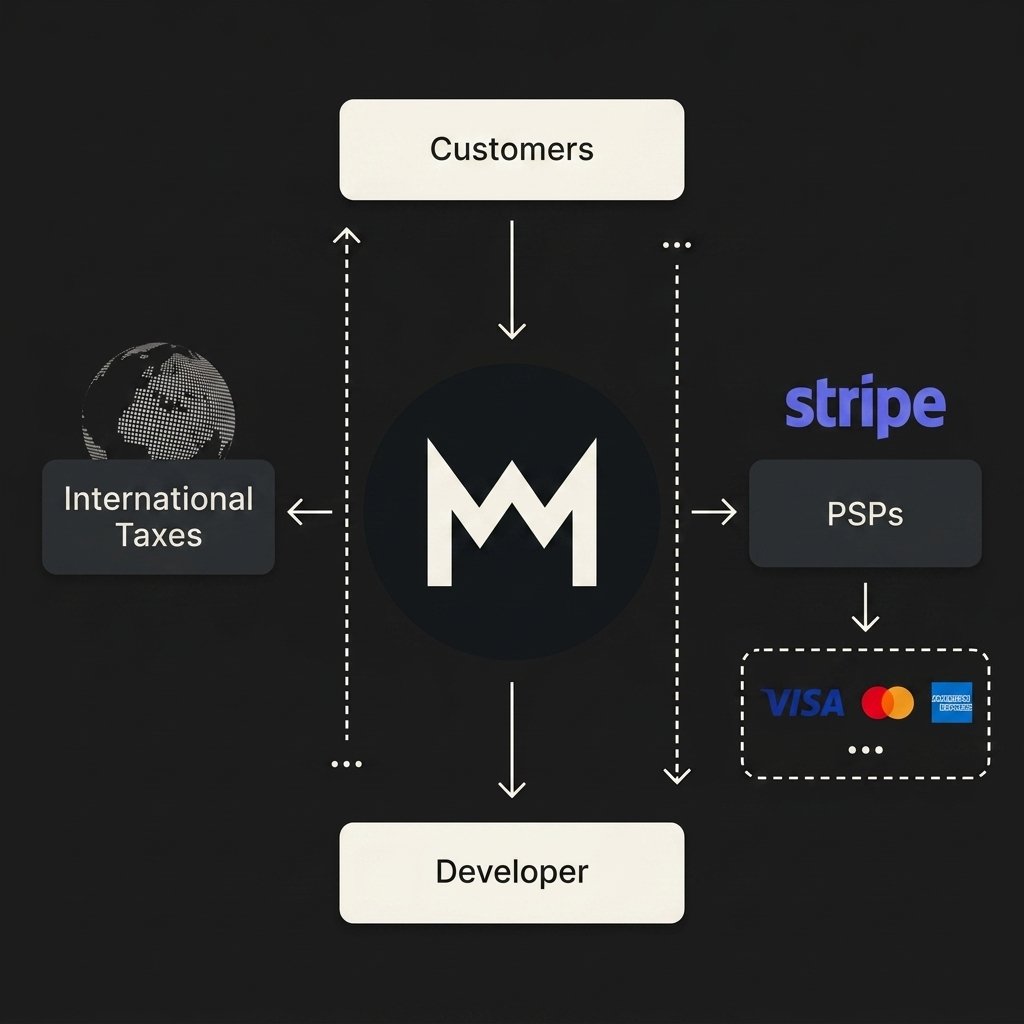
Merchants of Record
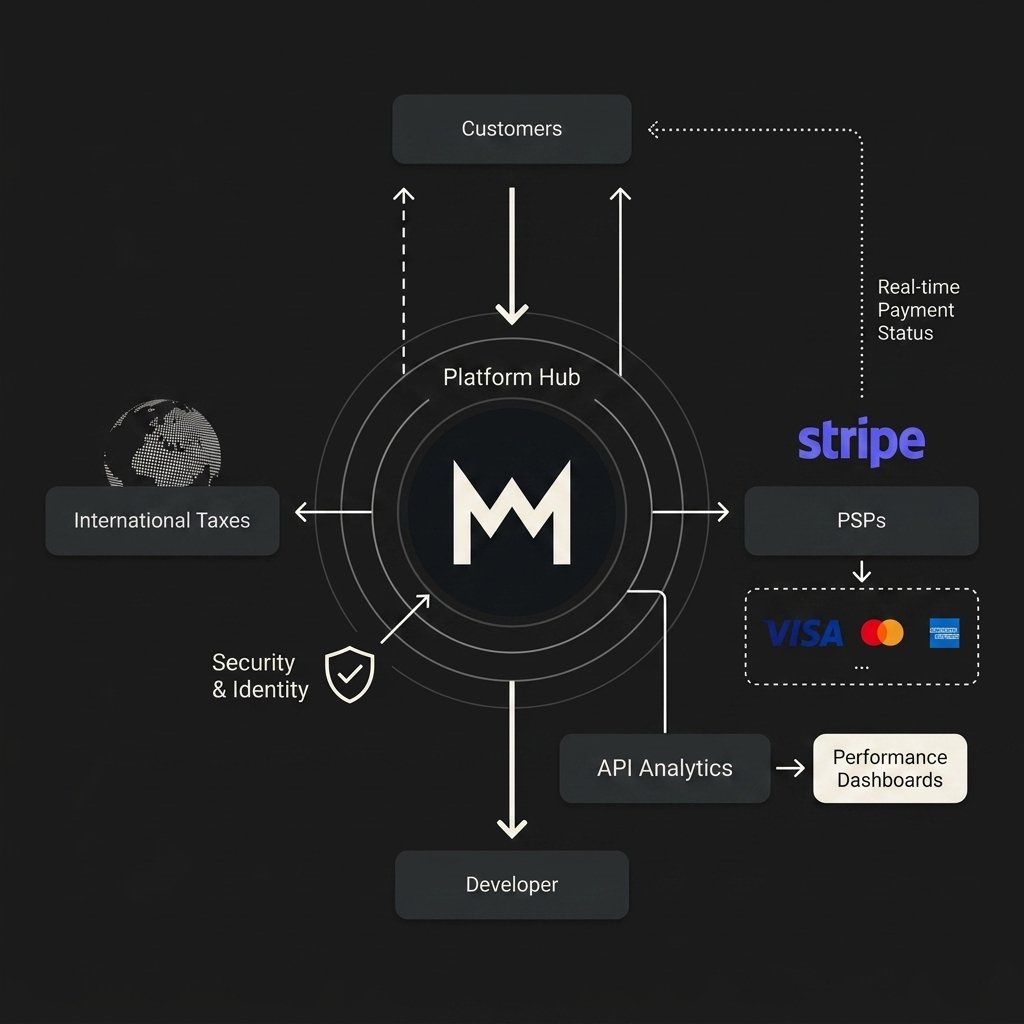
Built for usage and agent billing
Being the seller of record isn’t only about classic checkout. Macropay computes the correct tax at checkout regardless of pricing model — fixed, free, pay-what-you-want, seat-based, or usage-based metered billing. That matters most for the newest billing pattern: AI agents that bill by usage, activity, or outcome. Whether an agent is metered on tokens through the OpenAI-compatible AI proxy or charged on a certified outcome via the Signals API, the resulting sale still needs tax handled correctly in the buyer’s country — and as MoR, we do that for you on every transaction your agents generate.How we actually handle the tax
Most MoRs simply tell you “we handle tax globally, don’t worry about it.” We do too — but we’d rather show our work, so you can judge it (and decide whether to do it yourself).What “handling tax” means
Nearly every country, state, and jurisdiction taxes digital goods and services (VAT, GST, US Sales Tax), whether or not the seller is resident there. Compliance is two obligations:1
Capture
Charge the customer the correct tax-inclusive amount and ring-fence the tax
portion separately from your balance. Macropay computes the right rate at
checkout and holds captured tax apart from your funds.
2
Remit
File and pay that captured tax to each local authority on time. Macropay owns
registration, filing, and remittance in every jurisdiction where we’re the MoR.
- A consumer pays €23.80/month; €3.80 is ring-fenced for the German tax authority.
- A VAT-registered business pays €20.00/month — the reverse-charge mechanism shifts the VAT accounting to the buyer.
The two paths, side by side
Macropay’s coverage
We support global payments and take on liability for international indirect taxes everywhere we operate, then expand formal registrations as the data warrants. Current registrations- United States — Macropay Software Inc. is a Delaware C Corp; registers for state Sales Tax as thresholds are reached.
- EU VAT — Irish One Stop Shop (OSS).
- UK VAT.
The economics, transparently. A new market costs us roughly $500** to
register, **~$300 per (roughly quarterly) filing, plus consultations and our own
reporting effort — on the order of $1,700 in year one and $1,200 per year after.
In a market with 20% sales tax, standalone tax liability starts to outweigh those
costs around **$6,000** in sales ($1,200 ÷ 20%). For Macropay, at a ~1.1% premium
over a raw PSP, we’d need about **$109,090** in that market before our spread covers
the accounting cost ($1,200 ÷ 1.1%).
Frequently Asked Questions
What is Macropay's VAT number?
What is Macropay's VAT number?
Macropay’s VAT number is
EU372061545. This is an EU One Stop Shop (OSS)
registration, which lets a non-EU business like Macropay (a Delaware C
Corporation) handle VAT for all EU countries through a single registration in
Ireland.Why doesn't my accounting software recognize this VAT number?
Why doesn't my accounting software recognize this VAT number?
OSS VAT numbers use the
EU prefix instead of country-specific prefixes (like
IE for Ireland). Some accounting software predates the OSS program or lacks
support for the format. You can usually enter the number manually if your
software allows overriding validation, or ask your vendor to add OSS number
support.